
XGBoost 3.3.0 Release
We are pleased to announce XGBoost 3.3.0. This release adds expectile regression, enables categorical feature support by default, expands SHAP support for vector-leaf multi-output trees, and includes a broad set of performance and scalability improvements across CPU, GPU, distributed training, Python, JVM, and the build system. In particular, GPU quantile sketching uses significantly less memory for training.
XGBoost 3.3.0 is available from the usual package channels. The complete release notes are available in the XGBoost documentation, and release artifacts are available on GitHub.
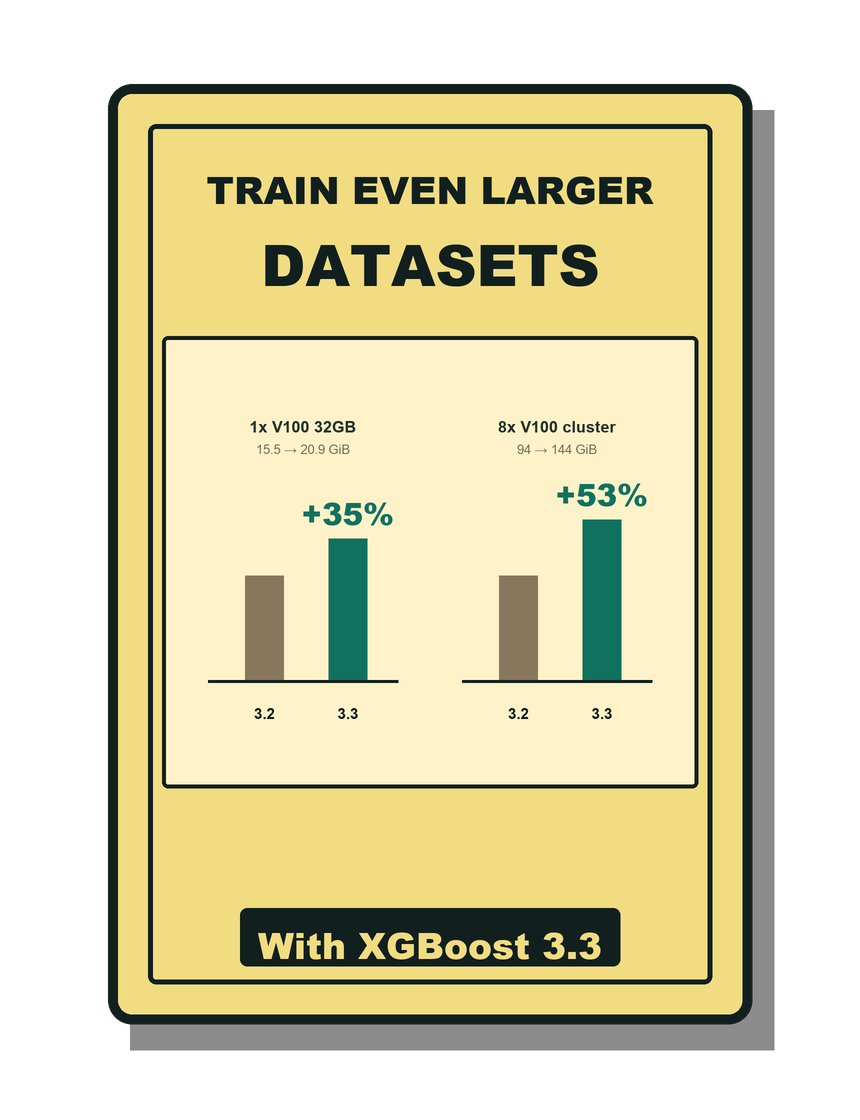
Faster quantile sketching and distributed training
Quantile sketching received a substantial refactor in 3.3.0. The internals are simpler, the weighted quantile sketch implementation is improved, and GPU quantile sketching uses significantly less memory.
These changes matter because quantile construction is a central part of the histogram-based training pipeline. Reducing memory use and simplifying the implementation improves robustness for large datasets, wide datasets, and GPU workloads where memory pressure often decides whether a job fits.
Distributed quantile construction is also more efficient in this release, using tree reductions to improve scalability. XGBoost no longer requires all-to-all collective connections for distributed training, and users can now customize the worker port when deploying distributed jobs.
Expectile regression
This release adds expectile regression, giving practitioners another tool for
risk-sensitive forecasting, uncertainty-aware modeling, and applications where
overprediction and underprediction carry different costs. It is available
through the new reg:expectileerror objective, the expectile metric, and the
expectile_alpha parameter.
Expectile regression is useful when users want an asymmetric squared-loss analogue of quantile regression. It gives a smooth objective for estimating different parts of the conditional response distribution, while retaining a squared-error style penalty.
Multiple expectiles are supported, allowing users to train models for several asymmetric targets in a single configuration. Unlike quantile regression, expectile curves do not suffer from crossing, which makes them easier to use when estimating multiple levels of the response distribution together. This complements XGBoost’s existing regression objectives.
Categorical features are on by default
Categorical feature support is now enabled by default. Users no longer need to
set enable_categorical=True in the common case. The parameter remains available
for users who need to disable categorical handling explicitly.
This change reflects the maturity of categorical support in XGBoost and makes the Python and dataframe workflows a little more natural. Dataframes with categorical columns can be passed into XGBoost without an extra opt-in step, making the default behavior match what many users already expect from modern tabular machine learning libraries.
The CPU hist tree method also gained one-hot categorical split support for the
work-in-progress vector-leaf model. Vector-leaf trees are still under active
development, but this release continues to close gaps in the feature set.
SHAP support for vector-leaf trees
XGBoost 3.3.0 expands SHAP support for vector-leaf multi-output trees. Exact SHAP contribution and interaction prediction are now available for vector-leaf multi-output trees on both CPU and GPU.
This is an important step for multi-output models. Vector-leaf trees can model relationships across targets directly by storing a vector of weights in each leaf, but users also need the same interpretability tools they rely on for single-output models. With this release, multi-output workflows gain a more complete explanation story.
The TreeSHAP implementation has also been updated for improved numerical
stability and faster execution with QuadratureTreeSHAP [1].
CPU and GPU performance improvements
On CPUs, histogram building has been optimized for wide datasets with column block tiling. XGBoost can also detect CPU cache sizes through Linux sysfs on aarch64, improving its ability to choose efficient execution strategies on modern ARM platforms.
On GPUs, sampling now uses Philox for faster random number generation. This release also continues the wider work on reducing GPU memory pressure and improving the efficiency of the training pipeline.
Training with sampling is now more reproducible within a single session. XGBoost uses a local random number generator and serializes the RNG state in the model configuration, so pickled models can retain that state across save/load boundaries. This helps when training multiple sampled models in the same process.
Python and Spark updates
The minimum supported Python version is now Python 3.12. This lets the project remove older compatibility paths and focus testing on actively supported Python versions.
The Python package also adds PySpark support for Spark Connect ML. This improves compatibility with the newer Spark client-server workflow and keeps the XGBoost Spark integration moving with the broader Spark ecosystem.
The release includes dataframe validation improvements as well. XGBoost now
requires Enum support from Polars and validates that pandas column names are
unique, helping users catch ambiguous feature inputs earlier.
Several Python fixes and cleanups are included: default verbose behavior is now
consistent between XGBClassifier.fit and XGBRegressor.fit, python -OO
crashes from missing docstrings have been fixed, boolean indicator features are
handled in trees_to_dataframe, and validation messages around feature
information and deprecated functions have been improved.
JVM, build, and platform updates
The JVM packages now document Spark 4.0 compatibility. Regressor and ranker
pipelines support columnar input, Java packages include automatic module names,
and xgboost4j supports FreeBSD.
On the build and platform side, XGBoost 3.3.0 adds support for Visual Studio 2026, updates CUDA Toolkit support, and fixes a number of CMake, macOS, and packaging issues. Linux packaging now uses a versioned shared object.
Deprecation notice
The gblinear booster is deprecated in XGBoost 3.3.0 and will be removed in a
future release. The linear model feature in XGBoost has been a niche feature and
has not been as actively maintained as the tree algorithms. It also does not
support or align with many capabilities in modern XGBoost, such as categorical
splits, interaction constraints, monotone constraints, and TreeSHAP-style
explanations.
XGBoost is primarily a decision tree library, and we have decided to focus
development on the tree algorithms and on keeping the interface consistent for
the features users rely on most. Users relying on gblinear should start
planning migrations to other estimators or workflows.
Upgrade
For Python users, upgrade with:
pip install --upgrade xgboost
For conda users:
conda install -c conda-forge xgboost
Please see the installation guide for platform-specific instructions, and the 3.3.0 release notes for the full list of changes.
References
[1] Wettenstein R, Mitchell R, Yu P. (2026) Quadrature-TreeSHAP: Depth-Independent TreeSHAP and Shapley Interactions. arXiv:2605.04497.
Many thanks to everyone who contributed code, reviews, testing, documentation, bug reports, and release work for XGBoost 3.3.0.